


High-speed train collision in southern Spain kills at least 21


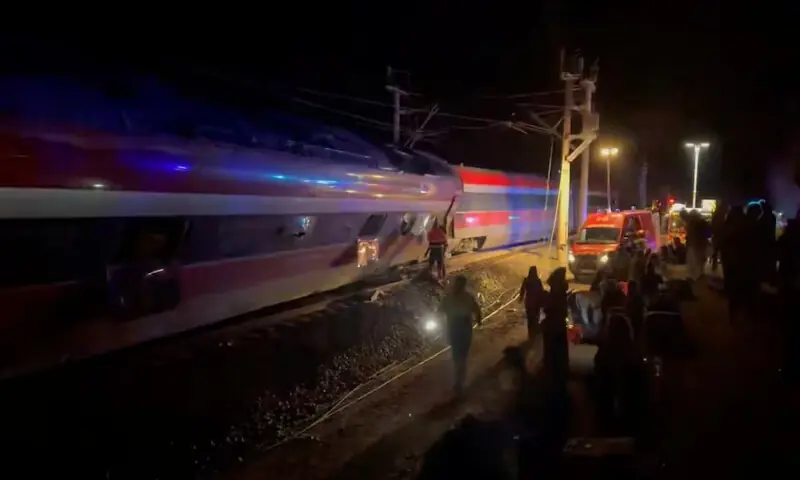
A high-speed train derailed and smashed into another oncoming train in southern Spain on Sunday, pushing the second train off the tracks and down an embankment in a collision that police sources confirmed had killed at least 21 people.
The accident happened near Adamuz in the province of Cordoba, about 360 km south of the capital Madrid.
Of the 75 people hospitalised, 15 are in serious condition, the chief of Andalucia’s regional government, Juanma Moreno, told reporters early on Monday.
He said the death toll would likely be more than 20 and warned the number may rise by daylight.
“The forcefulness of the accident has been very strong … we will likely find (more) corpses,” Moreno said, adding that heavy machinery would need to be used to remove the trains’ wrecked metal pieces and try to locate any new victims.
El País newspaper reported that the 27-year-old driver of the Madrid-to-Huelva train, the one that was struck, was among the dead.
There were around 400 passengers on the two trains, most of them Spaniards travelling back to and from Madrid after the weekend.
It was unclear how many tourists could be onboard as January is not the holiday season in Spain.
“There are many injured. I am still trembling,” Maria San José, 33, a passenger on the Malaga-to-Madrid high-speed train that first derailed, told El País.
A passenger on the second train, who was not identified, told public broadcaster TVE: “There were people screaming, their bags fell from the shelves. I was travelling to Huelva in the fourth carriage, the last, luckily.”
The second train, heading to Huelva and operated by state-funded Renfe, was travelling at around 200 km per hour at the moment of impact, reported El País.
It was unclear how fast the first train was travelling when it derailed.
The cause for the crash is not yet known, Spanish Transport Minister Oscar Puente told reporters at a press conference at Atocha station in Madrid, adding it was “really strange” that a derailment should have happened on a straight stretch of track. This section of track was renewed in May, he added.
Still people trapped
The accident happened at 7.45pm, about 10 minutes after the Iryo train left Cordoba heading towards Madrid, authorities said.
“The Iryo 6189 Malaga — (to Madrid) train has derailed from the track at Adamuz, crashing onto the adjacent track. The (Madrid) to Huelva train, which was travelling on the adjacent track, has also derailed,” Adif, which runs the rail network, said in a social media post.
Puente said most of those killed and injured had been in the first two carriages of the second train, the Renfe Alvia that derailed on impact and plunged down the side of the railway embankment.
The first carriage had 37 people on board and the second, 16, he said.
An Iryo-operated train travelling from Malaga to Madrid derailed, smashing into the Renfe train travelling from Madrid to Huelva, sending it careering down a railway embankment.
The Iryo train had more than 300 passengers on board, while the Renfe train had around 100.
Paco Carmona, Cordoba fire chief, told TVE that while the Iryo had been evacuated within hours of the accident, the Renfe carriages were badly damaged, with twisted metal and seats.
“There are still people trapped. The operation is concentrating on getting people out of areas which are very narrow,” he said.
“We have to remove the bodies to reach anyone who is still alive. It is proving to be a complicated task.”
Horrific scene
Spanish Prime Minister Pedro Sanchez cleared his schedule for Monday to address the tragedy, while the King and Queen were following the developments with concern, a spokesperson said.
Foreign embassies sent text messages to staff asking them to confirm they were safe.
Adamuz Mayor Rafael Moreno told El País that he was among the first to reach the crash site alongside the local police and saw what he believed to be a badly lacerated body several metres from the accident site.
“The scene is horrific,” he said. “I don’t think they were on the same track, but it’s not clear. Now the mayors and residents of the area are focused on helping the passengers.”
Local television images showed a reception centre set up for passengers in Adamuz, a town of 5,000 people, with locals bringing food and blankets as nighttime temperatures hovered around 6 degrees Celsius.
Tearful passengers disembarking from the bus spoke briefly to local press before being guided inside.
Salvador Jimenez, a journalist for TVE who was on board the Iryo train, shared images showing the nose of that train’s rear carriage lying on its side, with evacuated passengers sitting on its upturned side.
Jimenez told TVE by phone from beside the stricken trains that passengers had used emergency hammers to smash the windows and climb out, and they had seen two people taken out of the overturned carriages on stretchers.
Iryo is a private rail operator, majority-owned by Italian state-controlled railway group Ferrovie dello Stato.
The train involved was a Freccia 1000 train, which was travelling between Malaga and Madrid, a spokesperson for Ferrovie dello Stato said.
The company said in a statement that it deeply regretted what had happened and had activated all emergency protocols to work closely with the relevant authorities.
Renfe said the derailment of its train had been caused by the Iryo train derailing into its path, adding that emergency services were still recovering passengers.
Renfe said its president was travelling to the crash site and that it was working to support passengers and their families.
Adif has suspended all rail services between Madrid and Andalucia.
For the latest news, follow us on Twitter @Aaj_Urdu. We are also on Facebook, Instagram and YouTube.