


Big Oil offers reality check to Trump’s Venezuela dream


Big Oil companies have injected a heavy dose of realism into US President Donald Trump’s plan to rapidly invest billions in Venezuela, pointing to complex security, commercial and legal requirements to revitalise the country’s crumbling oil industry.
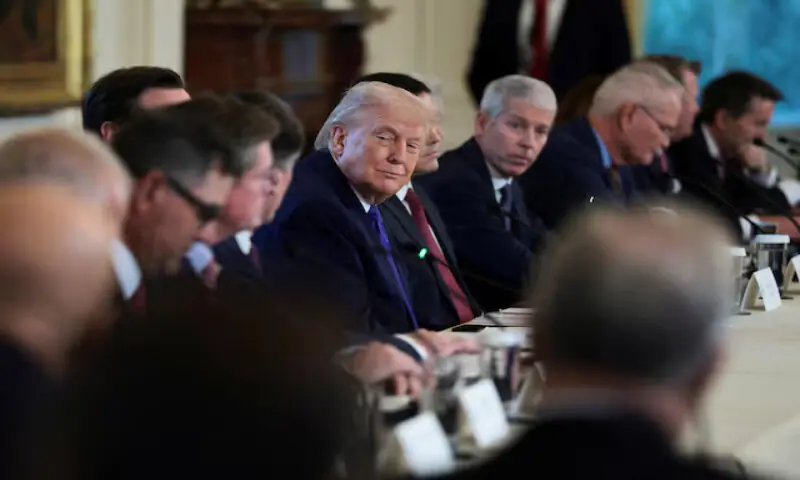
On the face of it, Friday’s televised White House meeting with the leadership of major US and European oil producers was a win for the US president.
It projected a sense of urgency, coming less than a week after the capture of Venezuela’s President Nicolas Maduro and his wife, and Trump received lavish praise from many executives around the table.
But the meeting was far from a ringing endorsement of Trump’s ambitions to see energy giants pour $100 billion into Venezuela’s oil industry, dramatically increasing its current production of around 900,000 barrels per day.
Indeed, Exxon Mobil CEO Darren Woods asserted that the Latin American country was currently “un-investible” from a commercial and legal standpoint.
That may seem like stating the obvious. Venezuela has been subject to tough US sanctions for nearly a decade, and its economy has suffered from decades of corruption and mismanagement.
Changing this reality would require several significant steps, beginning with the establishment of a government that can guarantee security on the ground and provide economic stability and fiscal confidence.
All that could take months, if not years.
Need for speed
Nevertheless, the Trump administration is moving fast.
Washington is working on lifting some sanctions on Caracas, Treasury Secretary Scott Bessent told Reuters on Saturday, which would help stabilise the economy and facilitate the sale of Venezuela’s oil, providing the country with badly needed cash.
However, more sanctions would have to be removed to allow oil companies to engage with national oil company PDVSA and for major oil services providers such as SLB and Halliburton to bring in essential drilling equipment, said Carlos Bellorin, analyst at consultancy firm Welligence.
Removing these restrictions could help unlock investment in so-called “low-hanging” barrels, including capital to revive wellheads that were abandoned in recent years and revitalise basic infrastructure from pipelines to port facilities.
Chevron, the only US company currently operating in Venezuela under a special licence, could lift its production by 50% within two years, from current levels of around 240,000 bpd, by upgrading equipment already in place, its Vice Chairman Mark Nelson told Trump on Friday.
On top of this, Spanish oil firm Repsol could triple its production of 45,000 bpd within two to three years, its CEO Josu Jon Imaz said at the meeting.
Getting money back
Most of the large international oil majors present in the White House meeting have a long history in Venezuela, meaning they have all had their fingers burned.
Two waves of oil industry nationalisation in the 1970s and 2000s forced many of them to hastily withdraw from the country, leaving behind huge losses they have yet to recoup.
“Oilfield service providers could be reluctant to commit resources in Venezuela because they’re still owed massive amount of money. So Venezuela should commit to pay oilfield service providers that debt as a way to have them in back,” Welligence’s Bellorin said.
But Trump appears to be suggesting the opposite.
When ConocoPhillips CEO Ryan Lance said his company was still owed around $12 billion from the 2007 nationalisation of its assets, Trump proposed Conoco could write the debt off despite years of fighting Caracas in international courts.
Lance proposed involving the US Export-Import Bank (EXIM) to restructure Venezuela’s debt to companies, which Trump appeared to reject.
Getting oil out
In the long run, unlocking Venezuela’s production, which at its recent peak in the 1990s exceeded 3.5 million bpd, will require fundamental changes to laws governing the country’s hydrocarbon sector.
For starters, Venezuela could revisit requirements for mandatory state participation in upstream joint ventures, which stands at more than 50%.
Caracas could also reduce the oil industry’s royalty and income tax rates of 30% and 50%, respectively, and modify PDVSA’s monopoly on marketing oil, according to Bellorin.
Below ground, questions remain over the quality of Venezuela’s oil.
Though the country boasts the world’s largest proven reserves, most of this is classified as heavy oil, which is typically more expensive to extract than other grades.
What’s more, many of Venezuela’s reserves are held by joint ventures with Chinese and Russian firms.
To attract substantial investments from international companies that have a fiduciary duty to shareholders, substantive financial and legal changes would be needed.
Verbal commitments from Trump will very likely not be enough to get companies to divert billions of dollars to Venezuela. The industry would need long-term certainty.
“We take a very long-term perspective,” Exxon’s Woods said.
“The investments that we make span decades and decades. So, we do not go into any opportunity with a short-term mindset.“
Checkmate?
The US oil companies may be throwing a wet blanket on Trump’s ambitions, but the energy execs are in a tricky spot.
Any signs of reluctance to invest in Venezuela risk raising Trump’s ire.
And the White House has shown its willingness to play hardball when it feels US businesses’ actions are not aligned with its interests.
Just look at the attacks on law firms and the recent threats to limit defence companies’ ability to return cash to shareholders.
In this environment, energy boards could determine that sinking a modest amount of money into Venezuela may be worth it, even if it’s not the best choice on paper, given the potential blowback from the administration otherwise.
But even if Venezuela sees a flurry of activity in the next few years, leading to moderate increases in the country’s oil production and sales on the open market, this likely will not be enough to make Venezuela’s oil industry great again.
For that, concrete action, not promises, will be needed.
For the latest news, follow us on Twitter @Aaj_Urdu. We are also on Facebook, Instagram and YouTube.