



Trump is ending deportation surge in Minnesota, White House border czar says




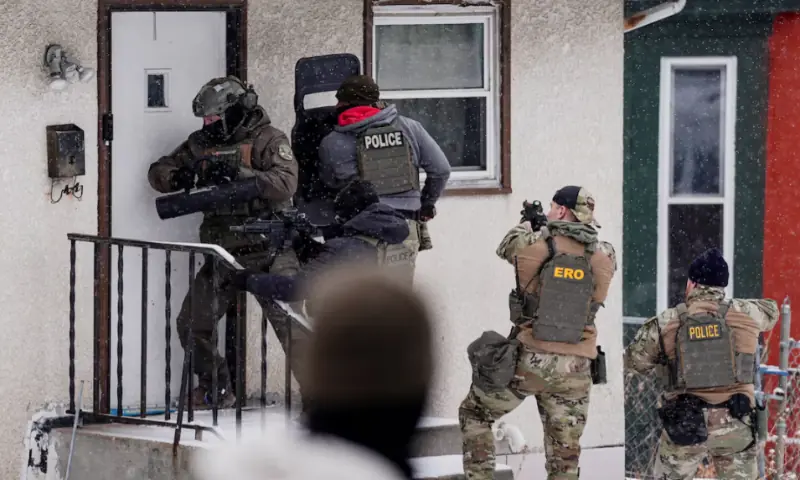
U.S. President Donald Trump has agreed to end his unprecedented and hotly protested deportation surge in Minnesota, White House border czar Tom Homan said on Thursday, with many immigration enforcement agents set to return to their home states over the next week.
Under Operation Metro Surge, Trump, a Republican, had deployed about 3,000 armed immigration agents by late January to deport migrants in Minnesota, over the objections and condemnations of Governor Tim Walz, a Democrat, and scores of residents who filled the streets of Minneapolis in protest.
On different days in January, immigration agents fatally shot two U.S. citizens in the state who had come out to protest or observe the agents, and Trump’s feud with Minnesota boiled over into one of the most fraught political crises he has faced in his presidency.
“I have proposed, and President Trump has concurred, that this surge operation conclude,” Homan told reporters at a news conference. “Operation Metro Surge is ending.”
It was a rare retreat by the Trump administration that came after even fellow Republicans raised questions about the operation. Promises of mass deportations had fueled Trump’s 2024 campaign, but support for his policies cooled as immigration officers were deployed in military-style gear on streets across the country, prompting massive protests.
A week ago, Homan announced that about 700 out of 3,000 immigration agents would be withdrawn. Without giving precise numbers, he said on Thursday that many of the remaining agents deployed from other states would be sent home in the coming week, citing in part what he called “unprecedented” coordination with local law enforcement agencies in Minnesota. Before the surge, about 150 immigration agents worked in Minnesota, according to the Trump administration.
“ICE will continue to identify, arrest and remove illegal aliens that pose a risk to public safety, like we’ve done for years,” Homan said, referring to the U.S. Immigration and Customs Enforcement, “and our officers will carry out those duties with professionalism, integrity and compassion, like we’ve done for years.”
Trump has said the surge was in the interest of public safety, describing many migrants, in sweeping terms, as violent criminals or fraudsters. Walz and other Minnesotans said the sometimes-violent federal surge has degraded public safety and impinged on the constitutional rights of both migrants and Americans.
“The long road to recovery starts now,” Walz said in a statement. “The impact on our economy, our schools, and people’s lives won’t be reversed overnight. That work starts today.”
‘THEY THOUGHT THEY COULD BREAK US’
Minneapolis Mayor Jacob Frey, who last month joined Walz in suing the Trump administration and asked a judge to restrain the surge, said in a statement that the increased deployment had been catastrophic.
“They thought they could break us, but a love for our neighbours and a resolve to endure can outlast an occupation,” Frey said.
The chief federal judge in Minnesota has reprimanded Trump administration officials, saying the U.S. Immigration and Customs Enforcement agency has defied dozens of court orders to free wrongly detained migrants.
Some of Trump’s fellow Republicans have also criticised the way the deportation surge has been carried out and how the administration has handled the killings of two Americans, Renee Good and Alex Pretti.
As Homan made his announcement, Minnesota Attorney General Keith Ellison was in Washington testifying before a Senate committee that oversees homeland security.
Rand Paul, the committee’s Republican chairman, criticised how the Trump administration had described Good and Pretti after they were killed. Homeland Security Secretary Kristi Noem and other administration officials initially called them “domestic terrorists.”
“The First and Second Amendments are not suspended during periods of unrest or during protests,” said Paul, a libertarian from Kentucky, referring to constitutional rights to free speech and to carry weapons. “When officials speak imprecisely or rashly about constitutional limits, especially in volatile moments, they risk inflaming the situation rather than stabilising it.”
In Minnesota, Avonna Starck, who runs an environmental nonprofit and sits on the school board of a Minneapolis suburb, was sceptical of Homan’s announcement.
“They’re not removing all agents, and that was the goal,” she said in an interview. “We as a community wanted all of the agents out of Minnesota.”
Starck said she would continue protesting the deportation efforts, working to ensure people who are staying home in fear they could be detained by immigration agents have food and access to education, and informing her neighbours about their rights.
Miguel Hernandez, a Minneapolis community organiser and owner of Lito’s Burritos, said there had been no accountability for the surge, particularly for the killings of Good and Pretti.
“They’re saying it’s over so that people will stop paying attention, but harm was done, and the harm continues to be done,” he said. “Our community is going to continue to be destroyed.”
For the latest news, follow us on Twitter @Aaj_Urdu. We are also on Facebook, Instagram and YouTube.