


Gold pulls back after historic rally, long-term outlook still strong




Gold prices experienced a dramatic reversal last week, reminding investors that the precious metal’s rise isn’t always linear, even as long-term prospects remain bullish.
After months of surging gains, gold fell more than 10% in intraday trading on Friday, marking its largest single-day decline since the early 1980s, according to Bloomberg News.
The drop came shortly after prices neared $5,600 per ounce, surpassing forecasts from many analysts.
“While it didn’t signal a major sell-off, the move triggered a short-term sell signal,” said Katie Stockton, technical strategist and founder of Fairlead Strategies.
“We view this as a temporary pullback, not a long-term correction.”
Gold has rebounded somewhat in the days following the decline, maintaining its status as a sought-after haven.
The metal gained 65% in 2025, its best annual performance in nearly 50 years.
“Gold has stood the test of time as a store of value,” Stockton added, noting its enduring appeal from ancient times to today’s high-speed global markets.
Drivers of Gold’s Strength
Analysts point to ongoing geopolitical tensions, economic policy uncertainty, trade concerns, and a weaker US dollar as key factors supporting gold.
Central bank buying has also bolstered the market, with global purchases exceeding 863 tonnes in 2025, and similar activity is expected this year.
“Central banks are increasingly shifting from currencies to gold to strengthen reserves and hedge against geopolitical risk,” said Suki Cooper, head of global commodities research at Standard Chartered.
Gold’s pullback coincided with the announcement that former Federal Reserve Governor Kevin Warsh will replace Jerome Powell as Fed Chair in May.
Warsh, viewed as a hawk on inflation, is expected to resist calls for aggressive rate cuts, reducing uncertainty and prompting some profit-taking in gold.
Market Volatility and Technical Support
The surge in gold earlier this year prompted speculative buying, forcing the CME in Chicago to raise margin requirements on derivatives contracts.
Technical analysts are closely monitoring price levels for guidance.
Stockton noted that gold could find support near its 50-day moving average, around $4,455 per ounce, with additional support at $3,924 and $3,775 if the pullback continues.
“The rapid rally required a correction,” said Cooper. “A pullback is healthy for the longer-term trend.”
Demand Patterns and Outlook
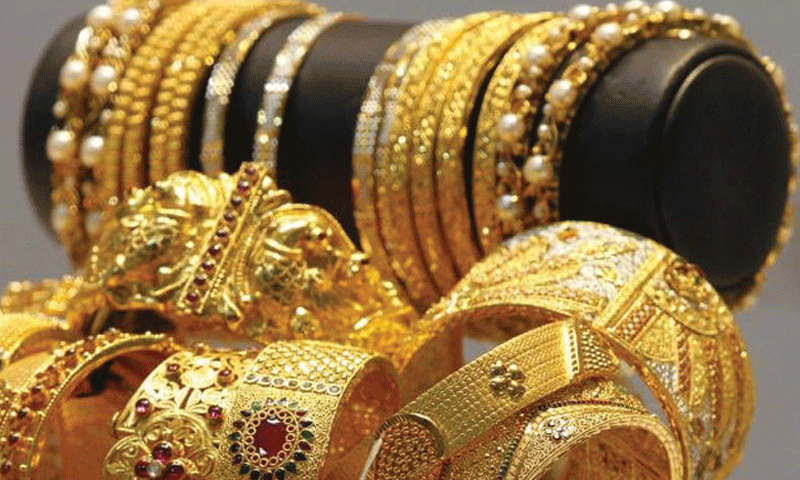
Institutional and high-net-worth investors remain the primary drivers of gold demand, while retail and jewellery purchases—especially in China and India—have slowed due to high prices.
Analysts say the Lunar New Year in China, starting February 17, could provide a key test for physical demand.
JP Morgan strategist Nikolaos Panigirtzoglou projected that if private sector allocations to gold rose from 3% to 4.6%, the metal could reach $8,000–$8,500 per ounce over the coming years.
For now, the gold market remains volatile after last week’s sharp swings.
Analysts expect weaker positions, particularly from retail investors who entered at peak prices, to be tested.
“Corrections tend to flush out overextended positions,” Cooper said. “But structurally, the factors supporting gold remain strong, suggesting the metal’s long-term outlook is still positive.”
For the latest news, follow us on Twitter @Aaj_Urdu. We are also on Facebook, Instagram and YouTube.