


No military operation underway in Tirah Valley: Khawaja Asif


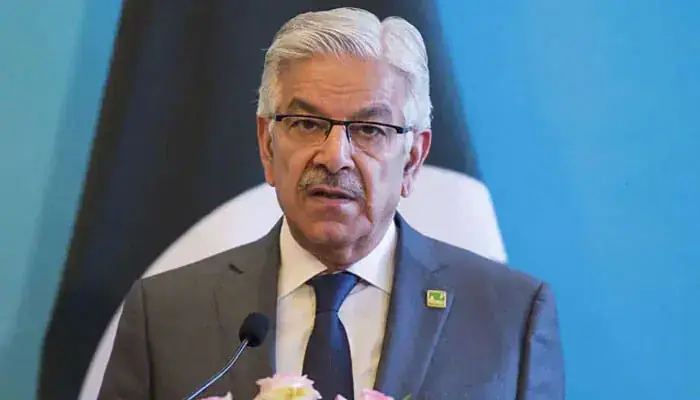
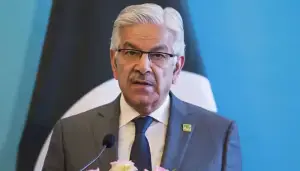
Defence Minister Khawaja Asif on Tuesday dismissed reports of a military operation in Tirah Valley, saying no such operation has taken place in the area for several years and that recent displacement is a routine, seasonal phenomenon linked to harsh winter conditions.
Addressing a joint news conference alongside Information Minister Attaullah Tarar and Special Assistant to the Prime Minister for Information and Khyber Pakhtunkhwa Affairs Ikhtiar Wali Khan, Asif said seasonal migration from Khyber’s border valleys, particularly Tirah Valley, was a long-established phenomenon documented even in British-era gazetteers.
“Tirah Valley experiences migration every year with the onset of snowfall. This is neither new nor unusual,” Asif said, noting that the area lies at an altitude of around 17,000 feet and becomes largely uninhabitable during peak winter months.
He rejected claims of any ongoing or recent military operation, saying no such action had taken place in Tirah Valley for several years. Asif accused the Khyber Pakhtunkhwa government of attempting to shift blame for its administrative shortcomings onto the army and the federal government by portraying routine migration as a crisis.
The defence minister said heavy snowfall across valleys along the Afghan border forces residents to temporarily relocate to safer areas, often leaving behind a few family members to safeguard property. He described the process as natural and historical.
Asif said a jirga comprising 12 to 13 elders was convened on December 11 and held consultations with the provincial government.
He added that some jirga members also met representatives of the proscribed Tehreek-e-Taliban Pakistan (TTP).
Following talks with the provincial authorities, a migration package was agreed upon and formalised through official documentation.
He stressed that the entire process was civilian-led and that the military or other security institutions had no role in the consultations or the migration arrangements.
Referring to past security operations, Asif said a military operation had taken place in the area several years ago but was concluded after the return of internally displaced persons.
He said the current situation reflected a lack of basic facilities, with no hospitals, schools or police stations in the valley, despite commitments made to the jirga to establish such infrastructure.
The defence minister alleged that around 12,000 acres of land in the area were under hemp cultivation, generating substantial profits that he claimed benefitted either influential political figures or the TTP.
He said federal efforts to establish schools, police stations and the writ of the state were facing resistance because they threatened entrenched interests.
Asif further alleged that certain elements within the provincial government had links with the TTP, accusing them of deliberately politicising the issue to conceal governance failures. He said civilian authorities and local elders were working to resolve the matter, while the province continued to blame a “non-existent operation.”
Information Minister Attaullah Tarar cited British-era official gazetteers, saying records from as early as 1880 noted that Afridi and Aka Khel tribes migrated from Tirah Valley during winters, underscoring the historical nature of the practice. He added that climate change had delayed the onset of migration this year.
Ikhtiar Wali Khan questioned the utilisation of a Rs4 billion package announced for migrants, noting that Pakistan Tehreek-e-Insaf had governed the province for 13 years.
“The provincial government must explain how much of this amount actually reached the affected people,” he said, adding that district administration had termed the migration voluntary and unrelated to the federal government or the military.
He also expressed concern that migrants could be used for political mobilisation during protests planned for February 8.
Asif said Tirah Valley becomes completely snowbound in winter, making permanent residence impossible, but clarified that intelligence-based operations against militants would continue. He said peace was a fundamental right of local residents and that jirga elders were respected community figures.
On the broader security situation, Asif said there was no proposal under consideration to reverse the merger of the former FATA with Khyber Pakhtunkhwa.
He noted a sharp rise in terrorism over the past two to three years, particularly after the Taliban’s return to power in Afghanistan, adding that Pakistan had held multiple rounds of talks with the Afghan authorities.
He said that responsibility for the lack of peace and services in Tirah Valley primarily rested with the provincial government, but assured that the federal government was ready to support provincial efforts and that assisting displaced people remained a state responsibility.
For the latest news, follow us on Twitter @Aaj_Urdu. We are also on Facebook, Instagram and YouTube.